
Home/Laser fume extraction
Guide
Laser fume extraction, explained properly
What fibre laser cutting actually produces, how extraction systems capture it, and why the dust collector is the most neglected component in most laser cells.
On this page
Fume extraction is the part of a laser cell that gets specified last, installed in a hurry, and then forgotten until the cut quality goes off. That is unfortunate, because on a fibre laser the extractor is not ancillary equipment — it is part of the cutting process, and it is the only thing standing between your operators and a lungful of metal fume.
What laser cutting fume actually is
When a fibre laser cuts steel, the beam vaporises and melts material at the kerf and the assist gas blows it clear. What comes off is not smoke in the everyday sense. It is a mixture of:
- Metal oxide fume — vaporised metal that condenses in air into extremely fine particles, typically well under one micron. This is the fraction that reaches deep into the lungs and the fraction that visible-dust intuition consistently underestimates.
- Larger particulate and spatter — heavier material thrown from the kerf, which mostly falls into the slat bed but some of which becomes airborne.
- Gaseous products from coatings, oils, protective films and mill scale burning off.
The important consequence: because the dangerous fraction is submicron, a system that looks like it is working can be performing badly. Clear air above the table tells you the coarse dust is being caught. It tells you very little about the fine fraction, which is exactly what a degraded cartridge filter starts passing first.
Materials and what they generate
Not all cutting is equal, and this drives both filter life and health risk.
| Material | Principal concern | Effect on the extractor |
|---|---|---|
| Mild steel | Iron oxide fume, respirable particulate | The baseline case. Predictable dust loading, reasonable filter life. |
| Stainless steel | Hexavalent chromium and nickel compounds — both carcinogenic, both with strict exposure standards | Fine, light fume. This is the application where filtration efficiency genuinely matters, not just airflow. |
| Galvanised & zinc-coated | Zinc oxide fume — the classic cause of metal fume fever | Heavy, very fine, sticky fume. Notorious for blinding cartridges far faster than mild steel. |
| Aluminium | Fine aluminium dust has genuine combustion and deflagration potential | Requires proper assessment of explosion protection, spark arrest and housekeeping for your specific installation. Do not treat it as ordinary dust. |
| Painted, oiled or filmed stock | Combustion products from the coating; oil carry-over | Oily fume glazes filter media and destroys cleanability. A major cause of premature cartridge failure. |
| Brass & copper | Copper and zinc fume | Fine fume, moderate loading. |
The practical point: a shop cutting mostly galvanised will burn through cartridges several times faster than a shop cutting mostly mild steel at the same duty. If your filter life seems short, the first question is not “are these cheap filters” — it is “what are we actually cutting, and is the pulse cleaning keeping up with it?”
How extraction on a plate laser works
A modern flat-bed fibre laser almost always uses zoned downdraft extraction. The bed is divided into sections beneath the slats, and dampers open only the zone the cutting head is currently working over. That is what makes the numbers work: you concentrate the full airflow of the extractor into a small area directly under the kerf, rather than trying to draw air across the whole table at once.
The chain looks like this:
- Capture at the bed zone, immediately below the cut.
- Transport through ducting to the collector, at a velocity high enough to keep particulate entrained rather than settling out in the duct.
- Separation — often a drop-out chamber or cyclonic pre-separator that removes heavy particles and spatter before they reach the filters.
- Filtration through cartridge filters, where the fine fraction is captured on the media surface.
- Cleaning — pulse-jet air blasts dislodge the accumulated dust cake into the hopper and bin, so the cartridge keeps working.
- Discharge of cleaned air, either back into the workshop or outside.
Every one of those six steps is a place the system can fail quietly. Most poor extraction performance is not a dead fan — it is a closed damper, a collapsed flexible duct, a pulse system that stopped cleaning three months ago, or a dust bin seal that turned the whole cabinet into a short circuit.
Why tube lasers are a different problem
Tube and profile lasers are the application people most often get wrong, because the plate-laser mental model does not transfer.
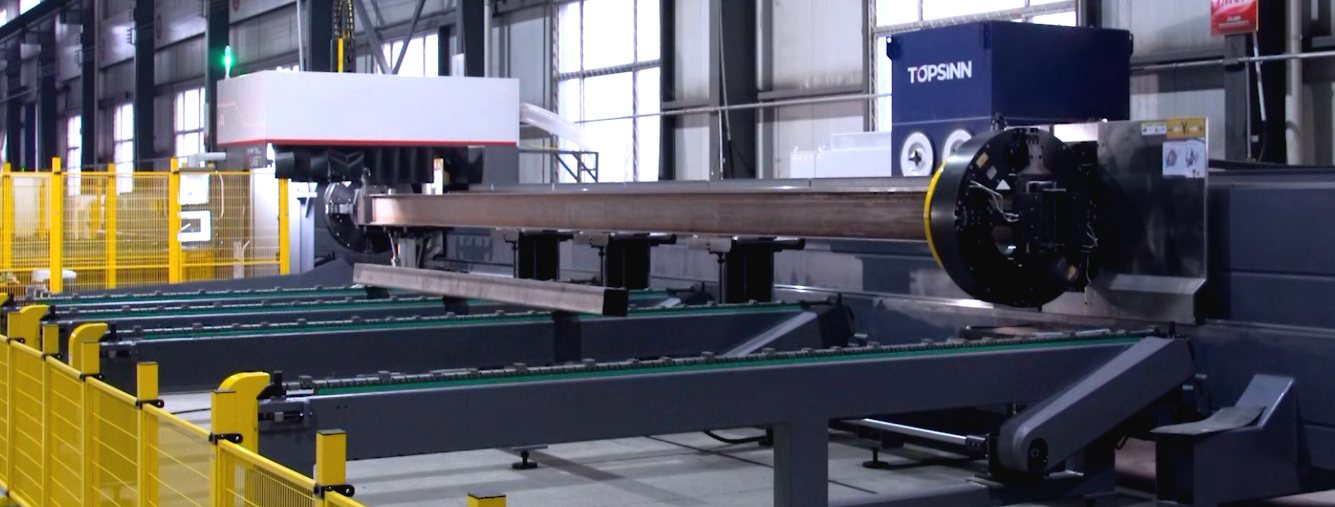
On a plate laser the workpiece is flat and the fume goes down into an open bed. On a tube laser:
- The workpiece is a duct. Fume and fine spatter travel inside the tube, away from any extraction hood, and are deposited internally along its length. This is why parts come off a tube laser with soot inside them.
- The cutting point moves along the machine as the tube feeds through, so a single fixed hood cannot follow it the way a zoned bed can.
- Chucks and supports obstruct capture. There is far less room for an effective hood close to the kerf, and capture velocity falls off extremely rapidly with distance.
- Off-cuts and slugs drop unpredictably, so collection has to handle solid debris as well as fume.
- Combination plate/tube machines are frequently sized on the plate duty alone, then the tube attachment is added later with no reassessment of the extractor.
If you are specifying extraction for a tube laser, or bolting a tube attachment onto an existing plate machine, get the capture arrangement looked at rather than assuming the existing collector will cope. It is a genuinely different capture problem, even when the total airflow figure looks adequate on paper.
The specifications that matter
Five numbers tell you most of what you need to know about a dust collector.
1. Airflow (m³/h)
The volume of air the unit can move. Quoted airflow is a rating under the manufacturer’s test conditions with clean filters. What you get in service is lower — sometimes much lower — once ducting losses and a partially loaded filter are in the picture. This is why measuring airflow at the machine is worth doing, and why a design margin matters. More on sizing →
2. Static pressure (Pa)
The pressure the fan can develop to overcome resistance. This is the specification most often ignored and it is the one that ruins installations. Long duct runs, tight bends, undersized duct, and loaded filters all consume static pressure. A unit with generous airflow but insufficient static pressure will not deliver at the table once it is connected to real ducting.
3. Filter area (m²) and air-to-cloth ratio
Total filtration surface across all cartridges. Divide airflow by filter area and you get the air-to-cloth ratio — effectively the velocity of air through the media. Push that ratio too high and you drive fine particulate into the depth of the media instead of collecting it on the surface, where pulse cleaning can remove it. The result is a filter that cannot be cleaned, blinds early, and gets blamed on quality. More filter area for the same airflow means longer filter life. It is one of the more reliable ways to compare two units on paper.
4. Filtration efficiency and media grade
Cartridge media is commonly rated to European classes such as F9, or to MERV ratings. For submicron metal fume, media grade is what determines whether the fine fraction is captured or passed through into the workshop — particularly relevant if the unit discharges filtered air back inside, which most do.
5. Cleaning method
Automatic pulse-jet (reverse-jet) cleaning fires a short blast of compressed air down each cartridge in sequence, flexing the media and dropping the dust cake into the hopper. Well-set-up pulse cleaning is the difference between cartridges lasting a year and cartridges lasting a month. Cleaning can be triggered on a fixed timer or on demand from a differential pressure setpoint — on-demand is generally kinder to filters and cheaper on air, because it only cleans when cleaning is warranted.
A worked example: Topsinn TODC-6L
To make the numbers concrete, here are the manufacturer’s published figures for one commonly encountered unit. We have reproduced them for identification and comparison; always confirm against the rating plate and documentation for your actual machine.
| Specification | Figure | What it means in practice |
|---|---|---|
| Airflow | 6,000 m³/h | Roughly 1,667 L/s. Suits a mid-size plate laser with zoned downdraft. |
| Air pressure | 3,600 Pa | Healthy static pressure — enough for a realistic duct run plus loaded filters. |
| Motor | 7.5 kW | Sets your electrical supply and starter requirement. |
| Supply | 380 V three-phase, four-wire | Australian supply is nominally 400/415 V 50 Hz — see the note below. |
| Cartridges | 6 | Order a full set. Mixing new and part-worn cartridges gives uneven cleaning. |
| Filter area | 120 m² | Air-to-cloth ratio of about 50 m³/h per m² — i.e. roughly 0.83 m/min media velocity. |
| Media | F9 grade | Fine-fume capable media class. |
| Stated efficiency | 99.99% | Manufacturer figure. Real-world performance depends on media condition and seating. |
| Stated emission | < 10 mg/m³ | Relevant if the unit discharges back into the workshop. |
| Compressed air | 0.6–0.7 MPa, oil and water free | Approx. 6–7 bar. The “oil and water free” part is not optional — see below. |
| Dust bin | 50 L | Determines how often someone has to empty it. Plan the access. |
| Weight | 900 kg | Matters for floor loading, transport and relocation. |
On the 380 V figure
Many imported units are specified at 380 V three-phase 50 Hz. Australian mains three-phase supply is nominally 400/415 V 50 Hz. The frequency matches and equipment is often rated to accommodate the voltage difference, but confirm it against the actual nameplate on your unit, and make sure motor overload protection was set to the measured full-load current rather than left at a factory default. All fixed electrical work in Australia must be performed by a licensed electrical worker.
Compressed air — the hidden dependency
This deserves its own section because it causes more premature filter failure than anything else we see.
Pulse-jet cleaning runs on your shop compressed air. If that air carries water or oil, every cleaning pulse sprays contamination directly onto the clean side of the filter media. Oil glazes the media; the dust cake stops releasing; the differential pressure climbs and never recovers. You then replace a full set of cartridges, and the new set does exactly the same thing, because nothing upstream changed.
If your cartridges are dying early, check these before you buy another set:
- Is there a dedicated filter-regulator and, ideally, a coalescing filter or dryer on the supply to the collector?
- Is the air receiver drain actually working, or has it been stuck for a year?
- Is supply pressure at the collector genuinely at spec during a pulse, not just at rest? A pressure that collapses when the valve fires means the pulse has no energy behind it.
- Does the compressor have enough capacity for the pulse demand on top of everything else in the shop?
- Is there oil carry-over from a worn compressor?
A cheap coalescing filter on the collector air supply pays for itself several times over on the first set of cartridges it saves.
What actually goes wrong
Ranked roughly by how often we find it:
- Nobody is trending differential pressure. It is the single most informative number on the machine and on most sites nobody has ever written it down. Without a clean-filter baseline you cannot tell a healthy filter from one about to fail.
- Pulse cleaning has quietly stopped. A failed solenoid, ruptured diaphragm or dead timer board does not raise an alarm on most units. The extractor keeps running and the filters slowly strangle.
- Wet or oily compressed air. As above.
- Leaks in the cabinet. A perished door seal or dust bin gasket lets the fan pull easy air from inside the cabinet instead of hard-won air from the table.
- Ducting sins. Flexible duct used for long runs, crushed sections, too many tight bends, undersized duct, or a blast gate somebody closed and forgot.
- Undersized for the machine. Frequently the extractor was matched to the original laser, then the shop bought a bigger machine, added a tube attachment, or moved to thicker material.
- Dust bin left full. Simple, common, and it destroys cleaning performance.
Questions we get asked
Can I keep running with a partly blinded filter?
You can, and the machine will let you, which is the problem. What you are actually doing is running the fan hard against a restriction, drawing more current, reducing capture at the table, and pushing fine particulate deeper into the media so that even a good pulse cannot recover it. You are converting a filter change into a filter change plus a motor. Change them on differential pressure, not when someone notices the smoke.
Should filtered air discharge inside or outside?
Both are used. Discharging inside recirculates conditioned air and avoids make-up air problems, but it means the filtration is the only thing protecting the workshop atmosphere — so media grade and filter condition become critical. Discharging outside is more forgiving of filter degradation but requires make-up air, and can raise environmental discharge considerations depending on your jurisdiction and process. Which is appropriate depends on your material, your building and your local requirements.
How long should cartridges last?
There is no honest single answer — it depends on material, duty hours, air-to-cloth ratio and the condition of the pulse system. Which is precisely why you trend differential pressure instead of relying on a calendar. Our filter guide walks through how to work out your own interval →
My laser dealer has gone quiet. Can you still support the extractor?
Yes — that is a large part of what we do. The extraction unit is separate equipment from the laser, and supporting it does not depend on the machine dealer still being interested. Send us photos of the rating plate.
Keep reading
Want a straight answer about your installation?
Tell us the laser, the extractor and what you cut. We will tell you whether it stacks up.