
Home/Plasma fume extraction
Guide
Plasma cutting fume extraction
A plasma table makes dust by the kilogram, and it makes it hot. That changes how the extraction has to be sized, how the ducting is run, how often you are changing filters, and how seriously you take fire risk. Here is what matters in practice.
On this page
- Why plasma is a heavier duty than laser
- Downdraft tables versus water tables
- Sparks, hot particulate and fire risk
- What you are cutting, and what it produces
- Sizing a collector for a plasma table
- Collector series built for this duty
- Maintenance differences that catch people out
- Oxy and flame cutting
- Questions we get asked
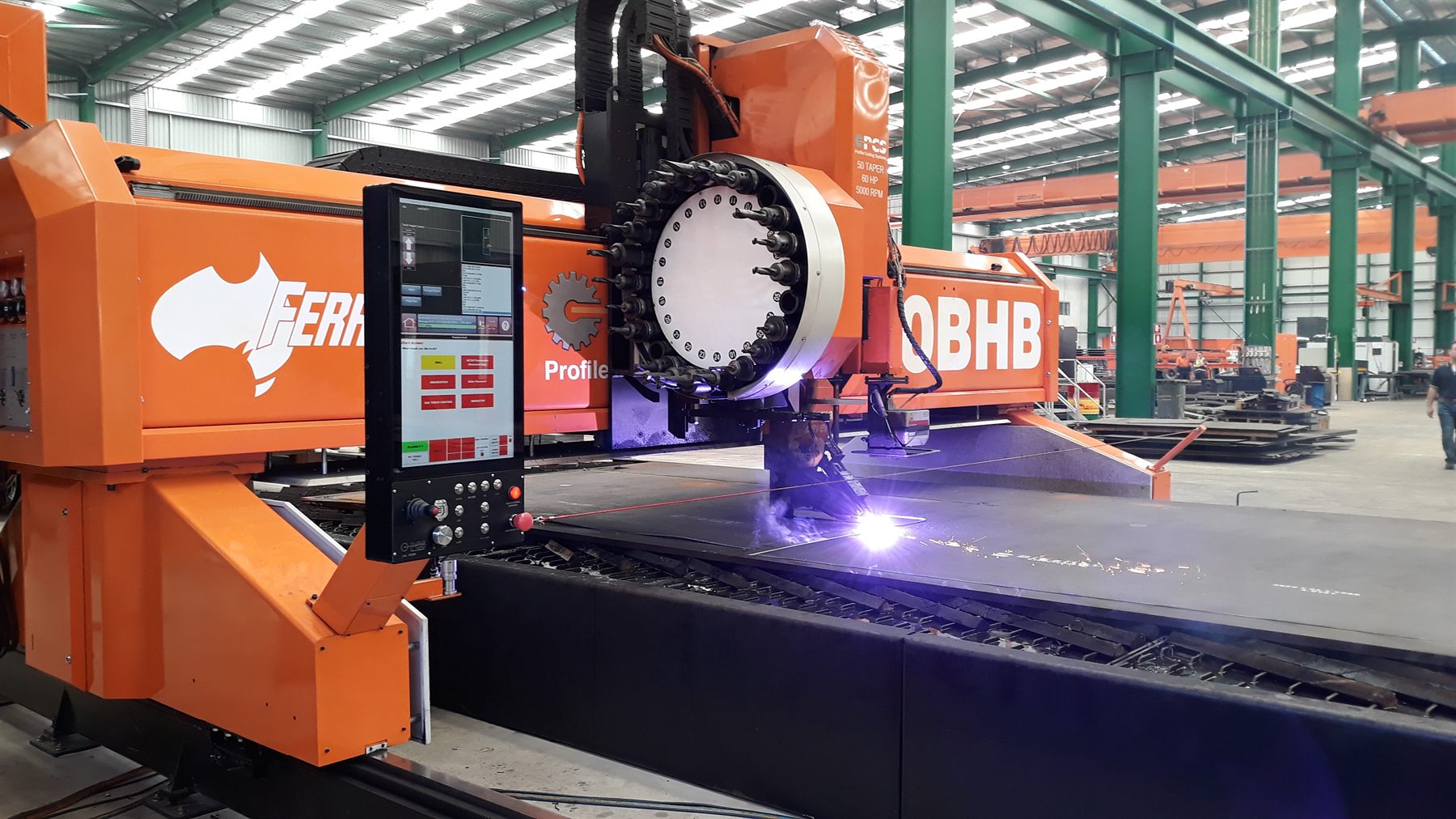
This is home ground for us. Our parent business, Profile Cutting Systems, has been designing, installing and servicing CNC profile cutting machinery in Australia since 1989 — most of that on plasma and oxy-fuel tables. The extraction that serves those tables, and the reasons it fails, is not something we picked up from a brochure.
Why plasma is a heavier duty than laser
The single most common extraction mistake we see in mixed shops is assuming that a dust collector sized for a fibre laser will cope with a plasma table. It will not, and the reasons are worth understanding rather than just accepting.
| Fibre laser cutting | Plasma cutting | |
|---|---|---|
| Kerf width | Narrow — typically a fraction of a millimetre | Substantially wider, and wider again as amperage and plate thickness climb |
| Material removed per metre | Low | Much higher — more kerf volume, usually thicker plate |
| Dust mass generated | Modest, and mostly very fine | Far greater by mass, and the collector fills bins accordingly |
| Particle size spread | Dominated by submicron metal oxide fume | Broad — submicron fume plus substantial coarse particulate, dross and spatter |
| Heat and ignition sources | Present, generally manageable | Significantly higher — hot particulate readily carried into ducting |
| Pre-separation | Often optional | Usually essential — a drop-out chamber or cyclone protects the cartridges |
| Cartridge life | Longer, more predictable | Shorter, and highly sensitive to whether pre-separation is working |
| Bin emptying | Occasional | Routine, and frequently the neglected task that kills performance |
The practical consequence: if you have added a plasma table to a shop that already ran a laser, do not assume the existing collector will stretch. And if you run one collector across both, size it on the plasma duty, not the average. The laser will be fine on an oversized system. The plasma will not be fine on an undersized one.
Downdraft tables versus water tables
Plasma cutting is served by two quite different approaches, and which one you have changes the extraction conversation completely.
Zoned downdraft tables
The same principle as a laser bed, usually on a bigger scale. The table is divided into plenum sections beneath the slats, dampers open only the zone the torch is working over, and the full airflow of the collector is concentrated there. Because plasma tables are often long, there are more zones, more damper linkages and more plenum to go wrong.
What we find on downdraft plasma tables:
- Dampers that no longer seal or no longer actuate. One stuck-open zone at the far end of the table bleeds away the capture you need at the torch.
- Plenums full of settled dross. Plasma drops a lot of solid material, and the plenum is where it accumulates until the cross-section is meaningfully reduced.
- Slat build-up restricting the open area, which changes the airflow distribution across the zone.
- Worn or missing zone seals, which have exactly the effect of a leaking door seal on the collector itself.
Water tables
Cutting onto or just above a water bath suppresses a large proportion of the fume at source, along with noise and arc glare. Many shops run them precisely so they do not need a large dust collector. That is a legitimate approach, but it trades one set of problems for another:
- Sludge management. The bath accumulates metallic sludge that must be removed, handled and disposed of — and depending on what you cut, it may be classified waste.
- Water treatment and contamination. Cutting stainless puts chromium and nickel compounds into the water. That water is not going down a drain.
- Corrosion of the table, the plate and anything else nearby.
- Fume is suppressed, not eliminated. There is still a plume at the cut, and shops often still need general or local ventilation to manage it.
Aluminium and water tables — a genuine hazard
Cutting aluminium over a water table can generate hydrogen gas through reaction of fine aluminium particulate with water. Hydrogen accumulating under a table or in a confined bath is an explosion risk, and there have been serious incidents. If you cut aluminium, this needs proper assessment of your specific table and process — not a rule of thumb from a website, and not an assumption that it has been fine so far. Talk to the table manufacturer and get competent advice.
Sparks, hot particulate and fire risk
This is where plasma extraction differs from laser extraction in a way that genuinely matters, and it is under-appreciated.
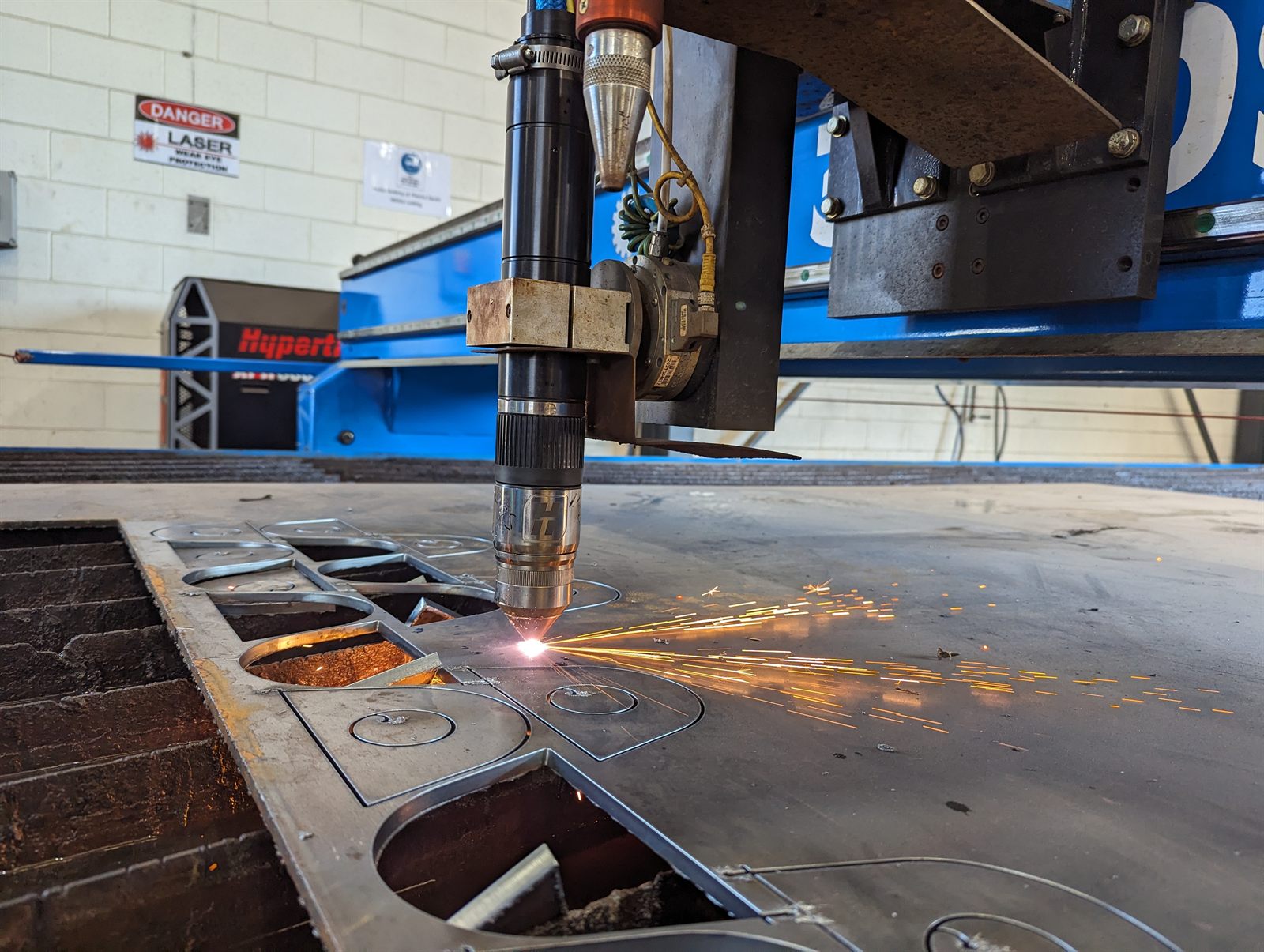
Plasma throws hot material. Some of it is carried into the duct while still incandescent. Every one of those particles is a potential ignition source arriving at a filter cartridge covered in a combustible dust cake, inside a cabinet with a hopper full of fines below it.
Things that reduce the risk, and that we look at on a plasma installation:
- Adequate duct run length before the collector, so hot particles have distance and time to cool.
- A drop-out chamber or cyclonic pre-separator to remove the heavy, hot fraction before it ever reaches the media.
- Spark arrest provisions appropriate to the installation.
- Fire-retardant filter media where suitable for the duty.
- Housekeeping in ducting and hoppers. Accumulated fines are the fuel load. This is the cheapest control available and the one most often skipped.
- Not leaving a full dust bin sitting under a hopper indefinitely.
If you are finding scorch marks, holes or burnt patches in your cartridges, that is not a filter quality problem. Stop and have the installation looked at.
Combustible dust. Where aluminium, titanium or certain other materials are cut, the collected dust can present a deflagration hazard requiring explosion protection provisions, and that is an engineering assessment specific to your installation and your process. Some collector series are built with explosion-protection provisions for exactly this reason. We will tell you when your situation calls for that assessment rather than guessing at it.
What you are cutting, and what it produces
| Material | Principal concern | Effect on the collector |
|---|---|---|
| Mild steel plate | Iron oxide fume and respirable particulate | The bread-and-butter case. Heavy dust mass, predictable, bins fill fast. |
| Primed or painted plate | Combustion products from the coating | Adds a sticky, sometimes oily component that shortens cartridge life noticeably. |
| Mill scale and rusty stock | Additional coarse particulate | Increases the load on pre-separation rather than on the media. |
| Stainless steel | Hexavalent chromium and nickel compounds — carcinogenic, strict exposure standards | Filtration efficiency and filter integrity matter far more than throughput here. |
| Galvanised | Zinc oxide fume — metal fume fever | Very fine, sticky, and hard on cartridges. |
| Aluminium | Combustible dust; hydrogen generation if cut over water | Requires proper assessment. Do not treat as ordinary dust. |
Sizing a collector for a plasma table
The method is the same as for a laser — airflow, static pressure, duct velocity, filter area — but every number lands differently.
- Start with the table manufacturer’s stated extraction requirement. Downdraft plasma tables are designed around a specific airflow through an open zone. That figure beats any rule of thumb.
- Airflow requirements run higher than laser equivalents, driven by zone area on what are typically larger tables.
- Static pressure is usually the binding constraint. Plasma collectors are commonly sited outside the building or well away from the table, so the duct run is long. Add the pressure drop across a pre-separator on top of the loaded-filter resistance.
- Duct velocity must stay high enough to keep coarse particulate entrained. Plasma dust is heavier than laser fume; a velocity that would be fine on a laser installation will let plasma particulate settle out and progressively choke the duct — which is a fire load as well as a restriction.
- Be generous with filter area. Given the dust loading, a lower air-to-cloth ratio pays for itself in cartridge life faster on plasma than on any other application.
- Plan the bin. Volume, access, and how someone actually gets a full bin out without wearing it. On a busy plasma table this is a routine task, not an annual one.
The full method, with a worked example on air-to-cloth ratio, is in our extractor sizing guide.
Collector series built for this duty
Topsinn produces its dust collectors in several series, and the heavier-duty ranges exist precisely because plasma and flame cutting are not laser cutting. If you are identifying what you have, or working out what a replacement needs to be:
| Series | Noted application | Relevance to plasma |
|---|---|---|
| TODC-P | Plasma and flame cutting tables | The series aimed at this duty. The TODC-12P, for example, is published at 12,000 m³/h with a 15 kW motor and 12 cartridges — note the airflow and the cartridge count relative to laser-oriented models. |
| TODC-L / TODC-B | Laser cutting | Frequently found on plasma tables in mixed shops. Worth checking the numbers rather than assuming. |
| TODC-LEX | Applications with explosion-protection provisions | Relevant where a combustible dust assessment calls for it. |
| TODC-C / TODC-SH | General fume and dust collection | Encountered on lighter installations and general shop duties. |
We supply cartridge filters and spare parts across these series, and we will tell you honestly if the unit you have is simply the wrong size for the table it is serving.
Maintenance differences that catch people out
If you have moved from laser to plasma, or you are running both, these are the things that change:
- Everything happens faster. Differential pressure climbs sooner, bins fill sooner, cartridges reach end of life sooner. Your laser service interval is not your plasma service interval.
- The pre-separator becomes a maintenance item. If a drop-out chamber or cyclone silts up, it stops separating and the coarse fraction goes straight onto the media. Cartridge life falls off a cliff and nobody knows why.
- The plenum and ducting need inspecting, not just the collector. Settled dross in a table plenum is invisible from outside and quietly costs you capture velocity.
- Bin discipline is a real control. A full bin on a plasma system is not a housekeeping nicety — it stops the dust cake falling clear, so pulse cleaning cannot work.
- Watch for burn evidence at every filter inspection. On plasma this is a safety check, not a curiosity.
- Compressed air still rules everything. Wet or oily air destroys cartridges just as thoroughly here, and you have less margin to absorb it.
Differential pressure trending is even more valuable on plasma than on laser, because the rate of change is faster and a problem shows up in weeks rather than months. How to trend it →
Oxy and flame cutting
Oxy-fuel profile cutting is slower and generates fume at a lower rate than plasma, but it brings a great deal of heat and produces a coarse, heavy slag and oxide. On multi-torch tables, several torches running simultaneously changes the arithmetic considerably.
Many Australian profile shops run combination tables — plasma plus multiple oxy torches on the same gantry. If that is you, size and assess the extraction on the worst-case simultaneous operation, not on the mode you use most often.
Questions we get asked
Can one dust collector serve both my laser and my plasma table?
Sometimes, if it is sized for the plasma duty and the ducting is properly designed with blast gates so you are not trying to draw both at once. What does not work is sizing on the laser and hoping. Get the combined arrangement assessed rather than tee-ing a second machine into an existing duct and seeing what happens — that approach usually ends with both machines under-extracted.
My plasma cartridges last a fraction as long as the ones on the laser. Is that normal?
Shorter life is entirely normal — the dust loading is far higher. A fraction of the life may still indicate something fixable, most often pre-separation that has silted up, a pulse system not cleaning effectively, or moisture and oil in the compressed air. Worth diagnosing before you simply budget for more filters.
Should I switch from a water table to downdraft, or the other way?
It depends on what you cut, what your site can accommodate, and what you are willing to maintain. Downdraft gives you dry, containerised dust and no water treatment, but it needs a properly sized collector and consumables. Water suppresses fume cheaply but hands you sludge, corrosion and disposal, and brings a serious hazard consideration if aluminium is involved. We are happy to give you a straight view for your specific situation.
Do you service plasma extraction as well as laser?
Yes — and given our parent business has been on plasma and oxy profile cutting tables since 1989, arguably it is the side we know best. Same service: filter changeouts, pulse-jet faults, loss of capture, motor and control repairs, plenum and duct inspection, airflow testing. More on what we service →
Keep reading
- Laser fume extraction, explained properly
- How to size a fume extractor
- Filter life, differential pressure and when to change
- Cartridge filters and spare parts
- Service, repairs and fault diagnosis
General guidance based on field experience with industrial cutting and extraction equipment. It is not a substitute for the manufacturer’s documentation for your equipment, a risk assessment of your specific installation, or advice from a suitably qualified professional. Fire, combustible dust and hydrogen hazards in particular require competent assessment of your own process.
Plasma table not pulling like it used to?
Tell us the table, the collector and what you cut. We have been doing this since 1989.